
La Partage in roulette: which bet only loses half to zero?
In the La Partage rule, the return of half when a 0 comes up is for covered even-money bets. It is not automatically half of all chips placed on the table.
For the topic overview, see Do line patterns or adjacent reels count?.

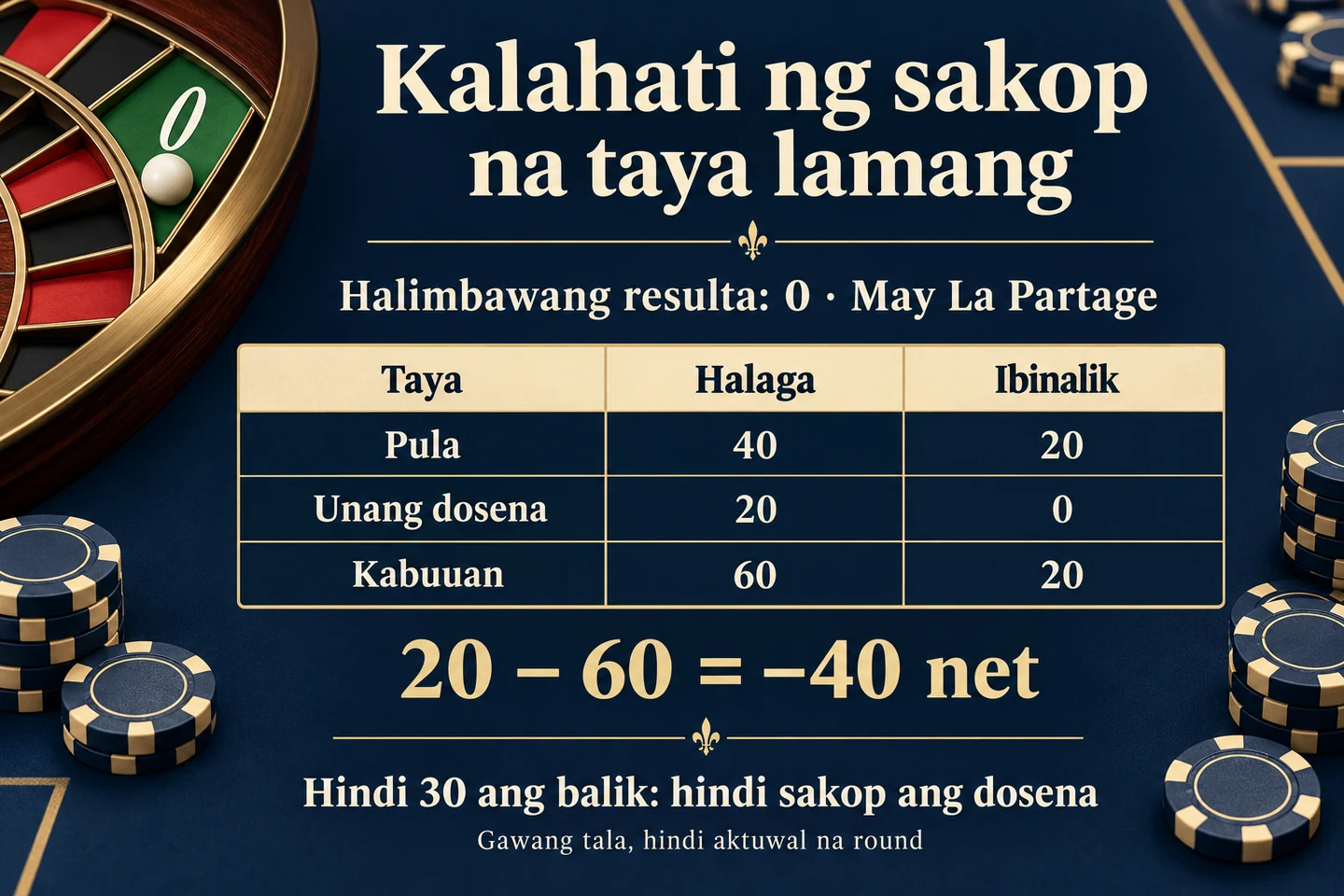
Consider two bets in one round: 40 units on the red and 20 on the first dozen. The zero came out. If the read rule is “return half,” it’s easy to take half of 60 and write 30. But an important detail is missing: half of which?
This is where the results of two similar roulette tables differ. Besides the wheel, the bet group and the special condition must be read at zero. This guide is related to live table topic in site homepage. It does not prove that a particular table is available to the operator.
Even-money is a type of payout, not an even amount of chips
In Evolution’s official explanation of roulette, describes La Partage in French Roulette as the rule that only half of the even-money stake is lost when the result is zero. The statement excludes all types of layout bets.
More detailed European Roulette help by Danske Spil: red/black, odd/even and low/high are listed as even-chance groups covered by La Partage. The dozen and column are in a separate payout group. This page has a stated update on 1 July 2020; we use this as a documented example of the rule, not proof of the current configuration in the Philippines.
“Even-money” usually refers to a 1:1 winning payout for such a bet group. It does not mean that any bet is covered as long as its value is an even number. Even if 20 is placed on the dozen, the dozen does not become an even-money bet because 20 is divisible by two.
There is another reason to read the rules themselves: the two sources use different names—French in one explanation and European in the other. The national label is not enough to know if the table in front of you has La Partage. Find the explicit rules and list of covered bets.
Both result 0, two clear settlement models
Let’s do two fake record. In each, 40 units are red and 20 units are the first dozen, so the total stake is 60. Both results are 0. No side bets, fees or other awards. In Model A, there is no La Partage and both bets on zero lose. In Model B, there is La Partage for red, but not for dozen.
| Bet group | Stake | Model A: no La Partage | Model B: only red is covered |
|---|---|---|---|
| red | 40 | 0 is returned | 40 ÷ 2 = 20 is the return |
| First dozen | 20 | 0 is returned | 0 is returned |
| Total | 60 | 0 is returned; net −60 | 20 is the return; net −40 |
In Model B, treating 60 ÷ 2 = 30 as the total return is incorrect. The calculated return is overstated by 10 because it includes half of the dozen bet’s stake, which is outside the covered scope. The arithmetic 60 ÷ 2 is correct; the calculation uses the wrong base.
It is also not correct to say “won by 20.” 20 is part of the earlier stake that was returned. There are 60 taken out, so the net is 20 − 60 = −40. The loss in this particular model is smaller than −60, but it’s still a loss.
Check the result on the balance, not just on the refund label
If the starting balance in each independent model is 100 units, it will be 40 after deducting the 60 stake. In A, there is no return so the end is 40. In B, there are 20 returned so the end is 60. The change from 100 to 60 is −40, which matches the worksheet.
For another little check, assume 18 on the odd and 12 on the column in the rule that covers the odd but not the column. If the result is 0, then 9 is half back from 18, not 15 from the total of 30. The net is 9 − 30 = −21. Again, the stake being an even number has nothing to do with eligibility.
These are conditional calculations for a given outcome. They are not probability models, house-edge comparisons or ways to predict the next number. It also does not include En Prison or other zero rules; separate reading is required if that is indicated in the table.
Four details before comparing roulette variants
- Exact game and variant. Record the name from the rules of the current table, not from the old promotional image.
- Result of running on special rule. Is zero indicated? Do not move the condition to another result or another wheel.
- List of eligible bet groups. Apply each recorded bet to the list. Do not combine the entire stake immediately.
- Method of settlement. Is it a refund, partial loss, pending stake or other treatment? Check the finalized history and unit value before creating a balance note.
If the history is missing, keep the missing detail as “unclear”. Zero return and unknown return are different things. There are other guides on guide library; for separate limit and support information, see responsible gaming page.
Wheel layout matters for another reason: roulette neighbours follow pocket order, which is different from adjoining boxes on the betting grid.
Questions about zero
When there is La Partage, is half of the total bet always returned?
Nope. Only half of the stake in the covered bet groups is used in this calculation. Other bets follow their own rules.
Is the word French or European enough in the name?
Nope. The name is the starting clue; the applicable rules will determine the zero treatment and eligible bets.
Is it safer to raise the stake because there is a partial refund?
That is not the conclusion of the worksheet. The entire stake can still be lost in other outcomes, and it does not measure the entire outcome distribution. A partial-refund rule is not a substitute for a fixed limit.
Checked two official sources on 4 October 2026. Values, balances and rounds in the article are own examples, not gameplay tests or claims about the operator. For 21+ readers.
Related reading
Roulette payout records: profit, returned stake and the whole round | bk8