
Roulette payout records: profit, returned stake and the whole round
A winning bet’s profit is not the same as the amount returned to the balance, and neither is automatically the net result of the whole roulette round. To reconcile a record, include the winning stake that comes back and the stakes on other bets that lose.
The bk8 roulette section covers variant and rule differences. Here we build one fictional three-bet worksheet to separate profit, gross return and round net. It explains accounting terms; it does not recommend a selection or confirm any table available on this site.
Define the paytable convention first
In this teaching model, “35 to 1” means 35 units of profit per winning unit staked, with the winning stake returned separately. The total return is therefore 36 units per unit. A model split pays 17 to 1 profit, giving an 18-unit total return; a dozen pays 2 to 1 profit, giving a 3-unit total return.
These are the explicit assumptions of our worksheet. A display saying “36×” may already include the stake. Adding another unit to that total would count the stake twice. Read whether the actual label means profit, total payout or a balance change before using it.
PlayNow’s Roulette! instructions, dated February 2021, distinguish straight, split and outside bets and direct readers to the applicable paytable. They also exclude zero from the listed outside bets. We use that documented coverage distinction as context, not as evidence of a current Philippine operator configuration.
Keep every accepted stake in the same round
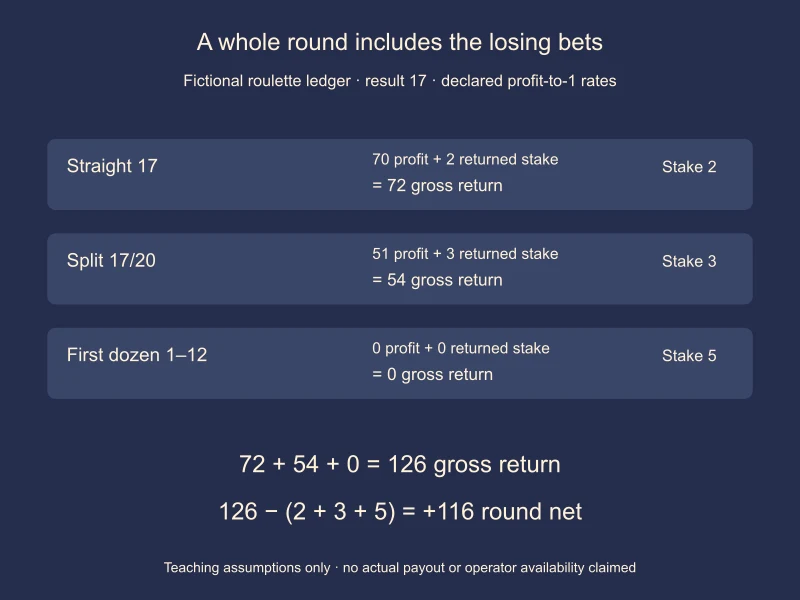
Assume an accepted 2-unit straight bet on 17, a 3-unit split covering 17 and 20, and a 5-unit first-dozen bet covering 1 through 12. The total debit is 2 + 3 + 5 = 10 units. No fees, side awards, special zero refunds or additional bets apply.
The straight and split overlap at 17. That does not merge them into one stake: they remain different accepted bets with separate amounts and payout rates. The overlapping roulette stakes guide explains the related difference between covered positions and money allocated to them.
Result 17: two winners and one loser
For the straight bet, profit is 2 × 35 = 70. Its own 2-unit stake also returns, so its gross return is 72. For the split, profit is 3 × 17 = 51, plus the returned 3-unit stake, giving 54. The first dozen loses and returns zero.
Total gross return is 72 + 54 = 126. Subtract the whole 10-unit debit once to obtain round net: 126 − 10 = +116. Adding just the winning profits gives 70 + 51 = 121; that omits the 5-unit loss on the dozen. Subtracting 10 from those profits instead would deduct the winning stakes again and incorrectly give 111.
| Accepted bet | Initial stake | Winning profit at 17 | Returned winning stake | Gross return |
|---|---|---|---|---|
| Straight 17 | 2 | 70 | 2 | 72 |
| Split 17/20 | 3 | 51 | 3 | 54 |
| First dozen 1–12 | 5 | 0 | 0 | 0 |
| Whole round | 10 | 121 | 5 | 126 |
Check the same selections against other invented results
If the result is 20, only the split wins. Its gross return is 54 and round net is 54 − 10 = +44. If the result is 5, only the dozen wins: its profit is 10, its returned stake is 5, and its gross return is 15. Whole-round net is 15 − 10 = +5, because the straight and split together lose 5.
If the result is zero, none of these three selections covers it. Under our no-special-refund assumption, gross return is zero and net is −10. A variant with a special zero rule must be checked independently. The existing La Partage scope example shows why a refund condition cannot be applied to all stakes without identifying the covered group.
The balance provides an independent check
Begin with a fictional balance of 200 units. After the accepted 10-unit debit, the balance is 190. With result 17, crediting 126 produces 316. The difference from the original 200 is +116, matching the net calculation.
The alternative check is the sum of individual bet nets: +70 for the straight, +51 for the split and −5 for the dozen. Their sum is also +116. We checked both methods for all 37 results from 0 through 36 under the declared worksheet rules; each agreed.
Do not infer settlement from an ambiguous win label
For an existing history, identify the round and final accepted stakes, then determine the units and payout convention. Keep stake, profit, gross return and whole-round net in separate fields. If a label’s meaning or the final accepted amounts are missing, mark them as unknown rather than manufacturing a balance.
All numbers and results here are fictional examples checked on 10 October 2026. No actual play, payout test or account transaction was performed. The worksheet gives no forecast, winning method or reason to increase spending.