
GUIDE · bk8
Roulette neighbours: count wheel positions, not the number grid
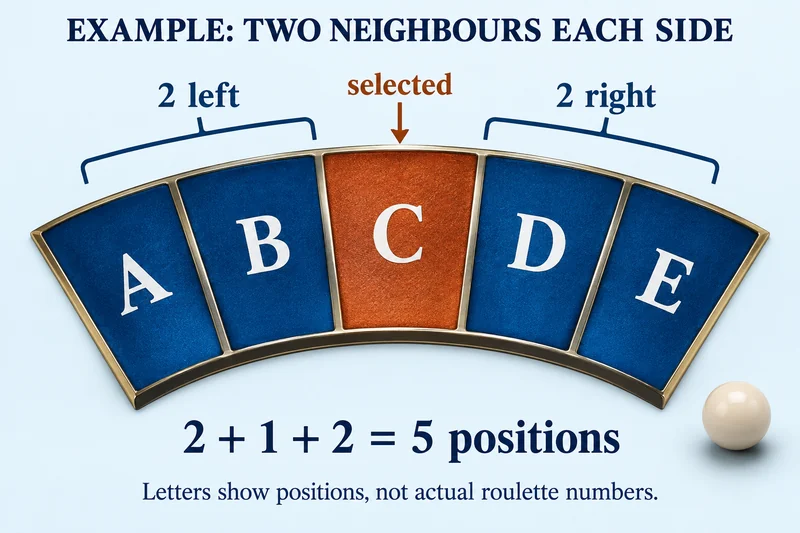
In a roulette neighbours selection, “next to” refers to positions around the wheel, not adjacent boxes on the rectangular betting grid. Counting two neighbours on each side of one selected pocket gives five positions: two, the selected pocket, and two more.
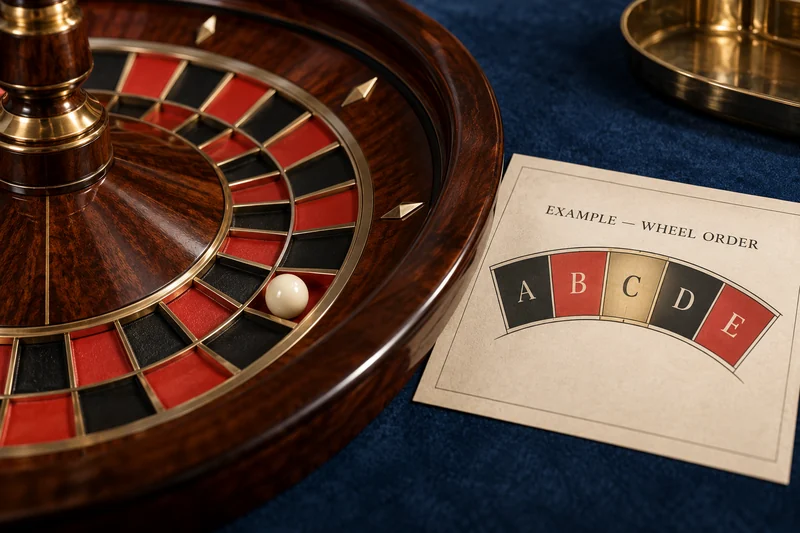
Two layouts serve different purposes
The table grid groups numbers in a convenient betting layout. The wheel places pockets around a circle in its own order. Moving one box left or right on the grid is therefore not a reliable way to identify the next pocket around the wheel.
Atlantic Lottery’s Original Roulette help describes its neighbours view as a portion of the wheel and explains that one selection can place chips on several adjacent numbers. This is a documented product example, not confirmation that the same control or configuration is offered elsewhere.
Count the selected pocket once
Our diagram uses letters A, B, C, D and E for five consecutive pocket positions. These are explanatory placeholders, not a real numbered wheel sequence. C is selected; B and A lie on one side, D and E on the other.
The covered positions are A, B, C, D and E. “Two neighbours each side” means four neighbouring positions plus the centre. It does not mean two positions in total, and it does not count C twice.
A small unit can represent several separate stakes
Assume a hypothetical selection puts one 3-unit chip on each of those five different numbers. The combined stake is 5 × 3 = 15 units. A visible 3-unit chip setting is the stake per position in this example, not the total for the group.
| Included positions | Chips under the stated assumption | Stake |
|---|---|---|
| Two on the left | 2 | 6 units |
| Selected centre | 1 | 3 units |
| Two on the right | 2 | 6 units |
| Total | 5 | 15 units |
The example excludes existing chips and overlapping selections. If a record contains several groups, inspect the final stake on each number; do not assume that a shared pocket was counted only once.
A wheel section is a grouping, not a forecast
Being neighbours does not establish that a pocket is due or that a nearby result makes the next outcome favourable. The diagram explains the identity and cost of a selection. It contains no prediction or claim of an advantage.
Check the actual variant, wheel view, neighbour-count label and confirmed total together. If the control counts a different scope, use that product’s definition. Do not transfer this five-position assumption to a button whose meaning is unknown.
The La Partage example deals with a different question: which wager groups receive special zero treatment. The roulette and table-game hub helps place these rules in context, and bk8 lists the other reading topics.
Source-based editorial research and original examples. Sources checked 2026-10-08.