
42, 43 and duplicate numbers: simple validity check for six-number sets
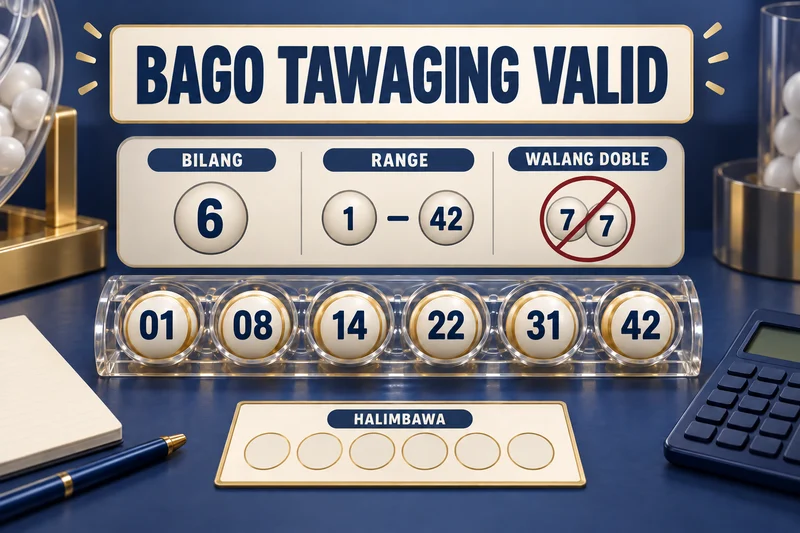
Before calculating the chance of a six-number line, first make sure that the input to the model being used is valid. Six distinct numbers in the correct range are required in an unordered 6/42 example. The list does not become valid just because six items are written.
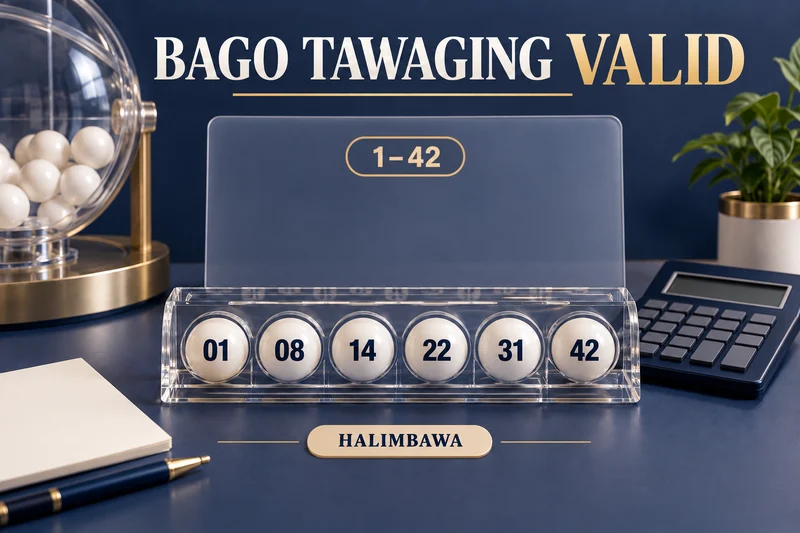
Three checks before calculation
| Fictitious input | Count/range/uniqueness | Model status |
|---|---|---|
| 01,08,14,22,31,42 | 6 distinct; all 1–42 | Valid on the stated 6/42 model. |
| 01,08,14,22,31,43 | 43 beyond the range | Invalid in model. |
| 01,08,14,22,31,31 | 6 items; 5 distinct | Invalid in model. |
| 00,08,14,22,31,42 | 00 out of 1–42 | Invalid in model. |
Game range, not wish list range
The Game Manual has game-specific number ranges and input formats. Do not use the 6/42 limit on 6/58, and do not use unordered-set validation on ordered 3D digits. The leading zero in 01 is formatting; 00 is a different value and is not part of the stated 1–42 range.
The denominator is just after it
For the valid uniform unordered 6/42 model, C(42,6)=5,245,786. An invalid six-item list is not automatically 1 in 5,245,786 accepted entries. The locally valid list is also not proof of confirmation. Actual confirmed record and correct draw identity are still required.
Do not silently adjust the raw record
If there is a 43 or duplicate 31 in the raw note, mark the issue; do not change to a new number to appear valid. Keep the original and separate proposed correction. In data review, unexplained replacement is more difficult to fix than a clear invalid flag.
Related reading
For other formats, read bingo and lottery hub. Naa library of guides the topics are more detailed; the bk8 has a general overview of the site.
Methodology: documentary reading and own example or calculation. Sources checked 6 October 2026; no ticket purchased or draw played for the guide. Hypothetical models are not live results, predictions or claim approvals.