
Roulette chip counts: convert each denomination before comparing stakes
Published — UTC

A stack of 100 chips can represent less money than a stack of 70. The chip count is not a monetary amount until the value of each chip is known.
Keep denomination beside the count
These are original records for an invented display, not accepted wagers at a named roulette table.
| Record | Chips | Value per chip | Monetary amount |
|---|---|---|---|
| A | 70 | 0.10 unit | 7 units |
| B | 100 | 0.05 unit | 5 units |
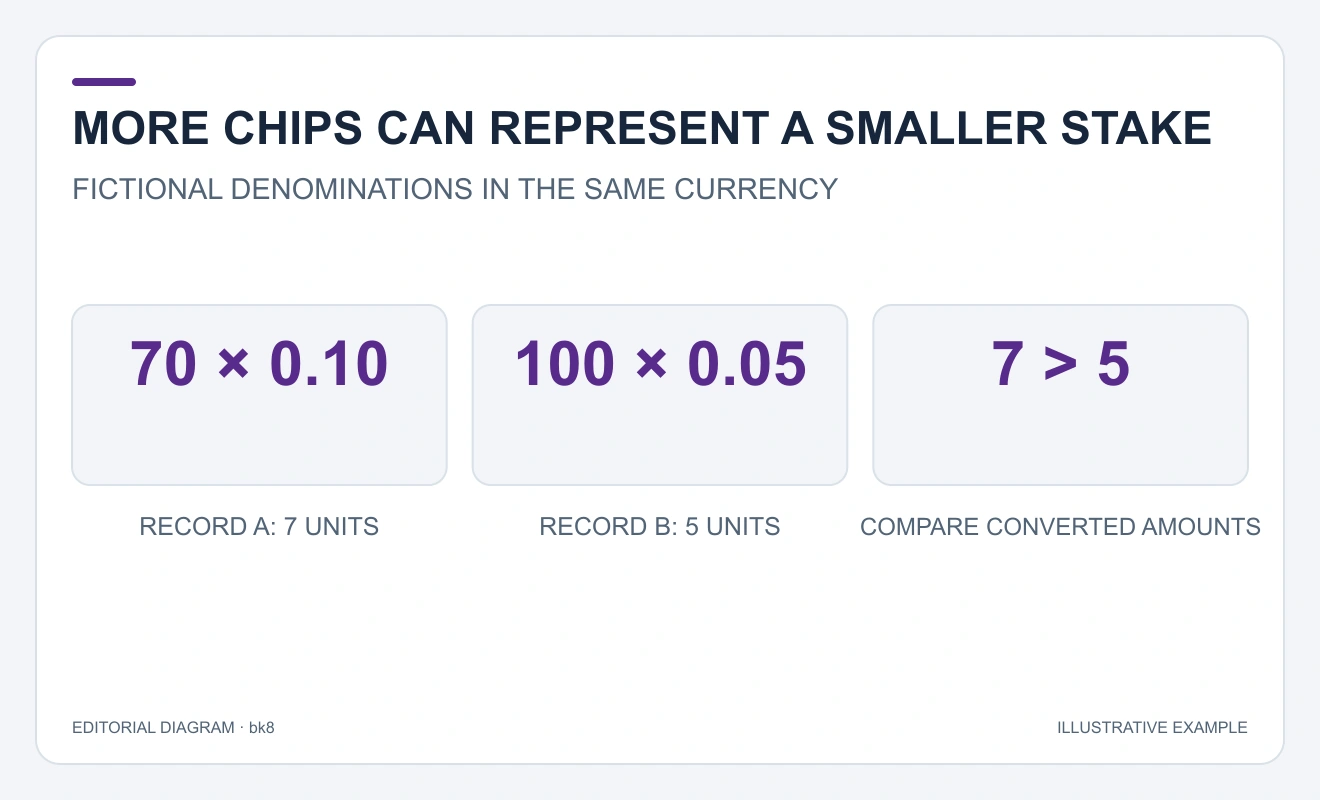
B contains 30 more chips but represents 2 fewer monetary units. Dividing 100 by 70 would compare counts; it would not calculate the ratio of the monetary stakes, which is 5/7.
A denomination change needs a boundary
Suppose an export changes its chip unit midway through a session. Convert each segment using its own recorded denomination. Applying the final denomination to all earlier rows can alter historical costs that were already accepted.
The British transaction-display reference includes credit conversion as a disclosure field. It does not establish the value of a local table’s chip.
Check currency and acceptance too
A virtual chip, practice credit and currency unit are not automatically interchangeable. Record whether the amount is a proposed placement or accepted stake. A control selected after the round cannot retroactively change the value of that round’s accepted chips.
A mixed rack needs a weighted sum
Suppose a third record contains 40 chips at 0.10 and 60 at 0.05. There are 100 chips, representing 4 + 3 = 7 units. Multiplying all 100 by the lowest denomination gives 5 and understates the amount; multiplying by the highest gives 10 and overstates it. Group identical recorded denominations, multiply each group, then sum the monetary amounts.
Count change and value change can have opposite signs
From original record A to B, the chip count increases by 30 ÷ 70, about 42.86%. Monetary amount falls by 2 ÷ 7, about 28.57%. Those percentages use different quantities but the same starting record. Neither is a payout rate or evidence that the wheel’s outcomes changed.
Chip colour does not supply the missing conversion
A photograph can establish that stacks look different, but a colour-to-value relationship needs the relevant table or account record. If an unlabelled stack could contain several denominations, leave its monetary amount unknown. Do not assign a familiar denomination from another table or infer a currency from the site’s visual theme.
A selected chip is not necessarily a charged chip
Imagine that 100 chips at 0.05 were proposed but only 80 were accepted before the round boundary. The accepted monetary cost is 4 units; the remaining 20 proposed chips do not create a one-unit charge without supporting account entries. If an accepted portion is later reversed, preserve that separate movement rather than silently editing the original count. Keep denomination, currency, acceptance status and any reversal identity together for each segment.